
Persistent painless lymph-node swelling, drenching night sweats, unexplained weight loss or an abnormal blood count does not identify the right specialist by itself. You will be able to match your symptoms and test results to the appropriate clinician, understand the lymphoma work-up, and compare Pune treatment centres before booking care.
Key takeaways
- Start with a general physician when symptoms or abnormal blood counts lack a clear cause.
- Ask whether a lymph-node biopsy has confirmed the lymphoma subtype.
- Compare treatment plans by subtype, stage, goals, side effects and second opinions.
- Choose a centre with pathology review, chemotherapy, transfusion and transplant referral access.
Which specialist should you see first for suspected lymphoma?
Start with a general physician when a new lump, fever or abnormal blood count has no clear explanation. Persistent painless lymph-node swelling, unexplained fever, drenching night sweats, unintentional weight loss, widespread itching, recurrent infections, abdominal fullness, unexplained anaemia or other abnormal blood counts justify a lymphoma doctor consultation in Pune.
| Specialist | When to see them | What they do |
|---|---|---|
| General physician | Symptoms are new and the diagnosis is unclear | Examines you and starts basic tests or referral |
| Hematologist | Blood-count abnormalities need assessment | Leads initial blood evaluation and related disorders |
| Hemato-oncologist | Lymphoma is suspected or confirmed | Combines blood-disorder diagnosis with cancer treatment; the most direct choice |
| Medical oncologist | Systemic cancer treatment is required | Leads medicines such as chemotherapy, antibodies or targeted therapy |
| Surgical oncologist | Tissue must be obtained or a mass requires surgery | Helps obtain a biopsy or remove a complication; surgery is not the usual lymphoma treatment |
| Radiation oncologist | Radiotherapy is appropriate | Plans and delivers radiation as part of the treatment team |
Tell the clinic whether you are newly symptomatic, awaiting biopsy, newly diagnosed or relapsing. Take scan reports, blood results and biopsy material if available.
Seek urgent care for severe breathlessness, rapidly enlarging neck or chest swelling, fainting, uncontrolled bleeding or inability to drink. During treatment, ask for the team’s fever threshold and emergency pathway; many cancer services treat 38°C or higher as urgent.
What does a hemato-oncologist do after a lymphoma referral?
After a lymphoma referral, the hemato-oncologist establishes whether lymphoma is present, identifies its subtype and maps its extent before recommending treatment.
1. The clinician reviews your symptoms, past illnesses, medicines, infections and previous reports. The examination covers every accessible lymph-node region, including the neck, above the collarbone, armpits and groin, and checks the liver and spleen. Tests can include a complete blood count, chemistry tests and LDH when indicated.
A peripheral smear can clarify selected blood-count abnormalities, but symptoms or a scan alone cannot establish lymphoma.
2. The decisive step is adequate tissue. Ask whether an excisional lymph-node biopsy is possible; when it is not, a properly sized core biopsy may work. Fine-needle aspiration often lacks the tissue architecture needed to distinguish lymphoma subtypes. The laboratory may use immunohistochemistry, flow cytometry and, for selected diseases, cytogenetic or FISH testing.
3. Ask whether a hematopathologist will review the original slides and paraffin blocks, especially after a small sample or an unusual diagnosis. The hemato-oncologist integrates that review with PET-CT, CT or MRI findings and decides whether bone-marrow examination is clinically required.
4. The specialist records the stage, selects treatment, checks response after therapy and plans surveillance for relapse or late effects. Ask for each conclusion in writing during a consultation with a hemato oncologist for lymphoma in Pune, including the tissue evidence, scans and reason for any additional test.
How do lymphoma subtype and stage change the treatment decision?
Two patients with “lymphoma” can need opposite treatment plans because subtype determines the disease’s biology, urgency and treatment goal. Hodgkin lymphoma, diffuse large B-cell lymphoma, follicular lymphoma, mantle-cell lymphoma and T-cell lymphomas are not interchangeable diagnoses.
- Hodgkin lymphoma is staged and risk-assessed differently from most non-Hodgkin lymphomas; selected cases use the International Prognostic Score.
- Diffuse large B-cell lymphoma and many T-cell lymphomas are aggressive diseases that usually need prompt systemic treatment.
- Follicular lymphoma is often indolent; selected patients without symptoms or threatening tumour burden can begin active surveillance instead of immediate treatment.
- Mantle-cell lymphoma has its own risk assessment and treatment strategies, which vary with age, fitness, symptoms and disease features.
The specialist records the Ann Arbor or Lugano stage, B symptoms such as fever, drenching sweats and unintentional weight loss, bulky disease and extranodal involvement. The International Prognostic Index applies to several non-Hodgkin lymphomas.
FDG PET-CT is central to staging FDG-avid Hodgkin lymphoma and many aggressive non-Hodgkin lymphomas. A bone-marrow biopsy is not automatic when PET-CT has already answered the staging question.
Stage IV means disease outside the original lymph-node region, not automatically incurable lymphoma. Before consenting, ask for the subtype, pathology evidence, stage, prognostic score and treatment objective in writing.
How should you compare lymphoma treatments and transplant recommendations?
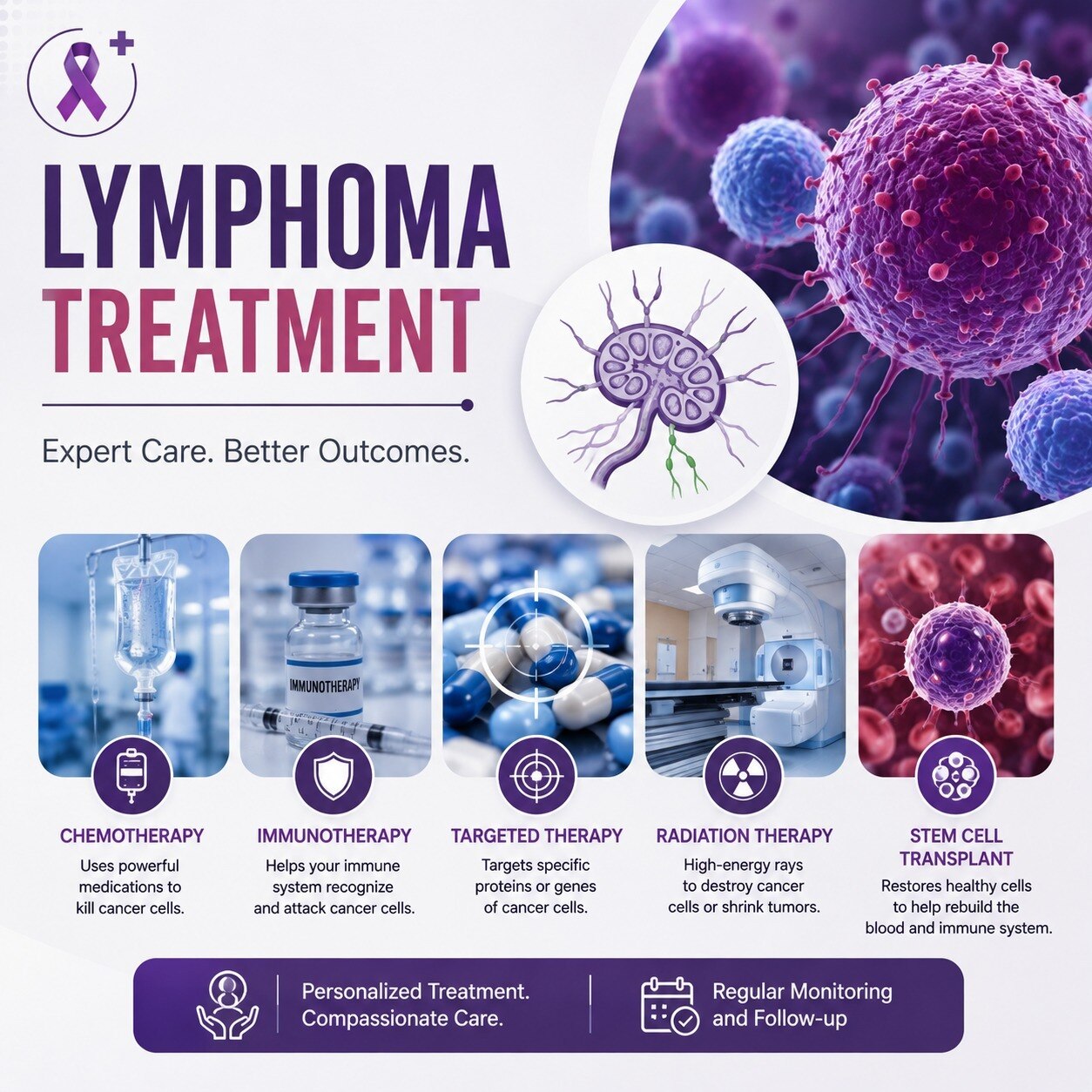
Do not compare lymphoma treatments as interchangeable recipes. The choice follows the subtype, stage, tumour bulk, symptoms, organ function, previous treatment and your goals. Chemotherapy, anti-CD20 or other antibody treatment, targeted therapy, immunotherapy and radiotherapy may be used alone or in combinations.
| Option | What it means | When it applies |
|---|---|---|
| Active surveillance | Planned reviews, blood tests and imaging without immediate treatment | Selected indolent lymphoma without symptoms; it avoids treatment toxicity |
| Systemic treatment | Drug treatment reaching lymphoma throughout the body | Most aggressive lymphomas, symptomatic disease or significant tumour burden |
| Radiotherapy | Focused treatment to a defined area | Selected localized disease, bulky sites or symptom control |
| Autologous transplant | Your own collected stem cells return after intensive treatment | Selected relapsed or treatment-resistant disease after response to salvage therapy |
| Allogeneic transplant or cellular therapy | Donor stem cells or engineered immune cells target lymphoma | Selected high-risk or relapsed cases; some patients are not candidates |
Active surveillance is not safe for many aggressive lymphomas, where delaying treatment can allow rapid progression. Before rituximab or another anti-CD20 treatment, request hepatitis B surface antigen, core antibody and surface antibody tests; normal liver tests do not replace screening.
Discuss sperm cryopreservation or oocyte or embryo cryopreservation before potentially gonadotoxic chemotherapy when time allows. A lymphoma treatment specialist in Pune should explain the treatment objective and transplant rationale in writing.
Confirm that the proposed centre performs autologous or allogeneic transplants, rather than only administering chemotherapy, and ask about its transplant unit, blood bank, intensive-care backup and 24-hour coverage.
How do you choose a lymphoma team and centre near Yerawada?
A nearby consultation is useful, but the treatment centre must match your lymphoma’s complexity. Searching for a hemato oncologist near Yerawada, compare convenience with pathology expertise, emergency access and transplant capability.
| Option | What it offers | When it fits |
|---|---|---|
| Nearby consultation | Faster reviews and less travel for blood counts, infusions and planning | Diagnosis, second opinion or treatment when urgent-care arrangements are clear |
| Larger treatment centre | Hematopathology, tumour board review, PET-CT, transfusion support and intensive-care backup | Complex, relapsed or high-risk lymphoma, or transplant evaluation |
Ask these questions before choosing:
- How many patients with my specific subtype—such as diffuse large B-cell, Hodgkin, follicular, mantle-cell or T-cell lymphoma—do you treat?
- Will a hematopathologist review the slides and paraffin blocks, and can a difficult case reach a multidisciplinary tumour board?
- Who handles fever, bleeding, neutropenia or tumour lysis syndrome between visits? Obtain the written fever threshold; many cancer services treat 38°C or higher as urgent.
- Which emergency department can provide prompt blood counts, cultures, antibiotics and transfusions?
Repeated infusions, blood tests, PET-CT scans, transfusions and rapid reviews make distance important. A short journey does not compensate for weak emergency arrangements.
For transplant care, verify a dedicated unit, accredited blood bank, infection-control facilities, intensive-care backup, donor-search capability when relevant and documented 24-hour coverage. Check registration through the National Medical Commission’s Indian Medical Register, then verify institutional accreditation and transplant scope separately.
Dr Chandrakant Lahane offers consultations in Yerawada, but request a written pathology, staging and referral plan.
Related services
Hematologist in Pune Dr. Chandrakant Lahane is an experienced Consultant Hematologist with over 15 years of experience in diagnosing and managing a wide range of blood... View service → |
Lymphoma Treatment Dr. Chandrakant Lahane provides specialized diagnosis and treatment of lymphoma, a type of blood cancer that affects the lymphatic system. View service → |
Frequently asked questions
Which specialist should you see first for suspected lymphoma?
Start with a general physician when a new lump, fever or abnormal blood count has no clear explanation. Ask for a lymphoma doctor consultation in Pune when lymph-node swelling persists or symptoms include drenching night sweats, unexplained weight loss, widespread itching, recurrent infections or abdominal fullness. The physician may refer you to a hemato-oncologist for lymphoma in Pune.
What does a hemato-oncologist do after a lymphoma referral?
A hemato-oncologist reviews your examination findings, complete blood count, imaging and biopsy results. The specialist confirms whether the tissue diagnosis identifies lymphoma, checks the subtype and stage, discusses treatment goals, and orders tests such as PET-CT, bone marrow examination or molecular studies when they affect the plan.
How do lymphoma subtype and stage change the treatment decision?
The subtype determines which medicines are effective, while the stage shows how widely the disease has spread. The plan also depends on symptoms, bulk of disease, organ involvement, blood counts, age, other illnesses and treatment response. Ask how each test changes the recommended treatment rather than treating a scan result as the diagnosis.
How should you compare lymphoma treatments and transplant recommendations?
Compare the diagnosis, treatment goal, expected response, schedule, major side effects, monitoring requirements and alternatives. Ask when a second opinion or pathology review is needed. A transplant recommendation should explain the indication, donor or stem-cell source, conditioning treatment, hospital stay, infection risks and what happens if the disease responds poorly.
How do you choose a lymphoma team and centre near Yerawada?
Look for a team that provides hemato-oncology consultation, access to expert biopsy and pathology review, PET-CT coordination, chemotherapy monitoring, transfusion support and referral for stem-cell or bone-marrow transplant evaluation. When comparing a hemato-oncologist near Yerawada, ask who coordinates care, where emergencies are handled and how quickly reports and treatment changes are communicated.
Related services
Blood Cancer / Leukemia Treatment Blood Cancer / Leukemia Treatment Dr. Chandrakant Lahane provides specialized diagnosis and treatment for blood cancers, including leukemia, with an individualized approach based on... View service → |
Bone Marrow Transplant Dr. Chandrakant Lahane provides specialized consultation and comprehensive care for patients who may require a bone marrow or stem cell transplant... View service → |
General Blood Disorder Care Dr. Chandrakant Lahane provides comprehensive care for a wide range of blood and hematological disorders, from common blood-count abnormalities to... View service → |