
A transplant plan starts well before conditioning chemotherapy or a stem-cell infusion. You need to know how the diagnosis is confirmed, how donor and organ assessments affect eligibility, what happens during admission, and which services continue after discharge so you can compare treatment plans and ask focused questions.
Key takeaways
- Confirm diagnosis, disease status, treatment history and performance status before deciding.
- Compare donor matching and stem-cell sources because they change preparation and risks.
- Ask what conditioning, stem-cell infusion and monitoring involve during admission.
- Request a written recovery plan covering infection precautions, medicines and follow-up visits.
How the specialist confirms eligibility before treatment
Eligibility starts with proof that transplant is needed and that its expected benefit outweighs its risks. The specialist confirms the diagnosis, reviews pathology and treatment history, measures disease status and risk, examines you, and records performance status. They also compare non-transplant options.
| Assessment | What it establishes | How it can change the plan |
|---|---|---|
| Blood and chemistry tests | Counts, electrolytes, kidney and liver function | Delays treatment or reduces conditioning intensity |
| ECG or echocardiography; lung-function testing | Heart and lung reserve | Identifies unsafe conditioning or extra monitoring |
| Marrow aspiration and biopsy, flow cytometry, cytogenetics and molecular testing | Residual disease, remission status and genetic risk | Supports, postpones or changes transplant |
| Infection screening, imaging and dental examination | Active infection, disease sites and oral infection sources | Requires treatment before immunosuppression |
The usual sequence is baseline blood and chemistry testing, organ assessment, infection screening and imaging, followed by disease-specific marrow testing. HLA typing and a donor search run alongside these assessments.
Review vaccination records and arrange fertility counselling before conditioning. Refer promptly for sperm, egg or embryo cryopreservation, or ovarian-tissue preservation when appropriate; chemotherapy and radiation can cause permanent infertility.
A second opinion or multidisciplinary review helps when transplant benefit is uncertain, conditioning intensity is debatable, or alternatives remain available. Ask for transplant treatment inclusions and bone marrow transplant specialist treatment for details, including testing, referrals and which services are on-site.
How donor type and stem-cell source change the plan
An autologous transplant returns your own previously collected stem cells after high-dose treatment. An allogeneic transplant uses donor cells, which can create a graft-versus-tumour effect but also brings graft-versus-host disease, graft failure and donor-derived infection risks.
| Option | Source | Main trade-off |
|---|---|---|
| Autologous | Your own collected cells | No graft-versus-host disease, but no donor immune effect |
| Matched sibling | Fully HLA-matched family donor | Usually strong compatibility; a suitable sibling is not guaranteed |
| Matched unrelated donor | HLA-matched volunteer | Can provide donor cells when family matching fails, with more search time |
| Haploidentical | Half-matched family donor | Rapid availability, with distinct graft-versus-host disease and immune-recovery risks |
| Cord blood | Umbilical-cord-blood unit | Greater HLA mismatch is possible, but engraftment and immune recovery can be slower |
HLA compatibility leads allogeneic donor selection. The team also weighs donor age, availability, sex, cytomegalovirus status, cell dose and your disease, because a perfect laboratory match is not the only practical consideration.
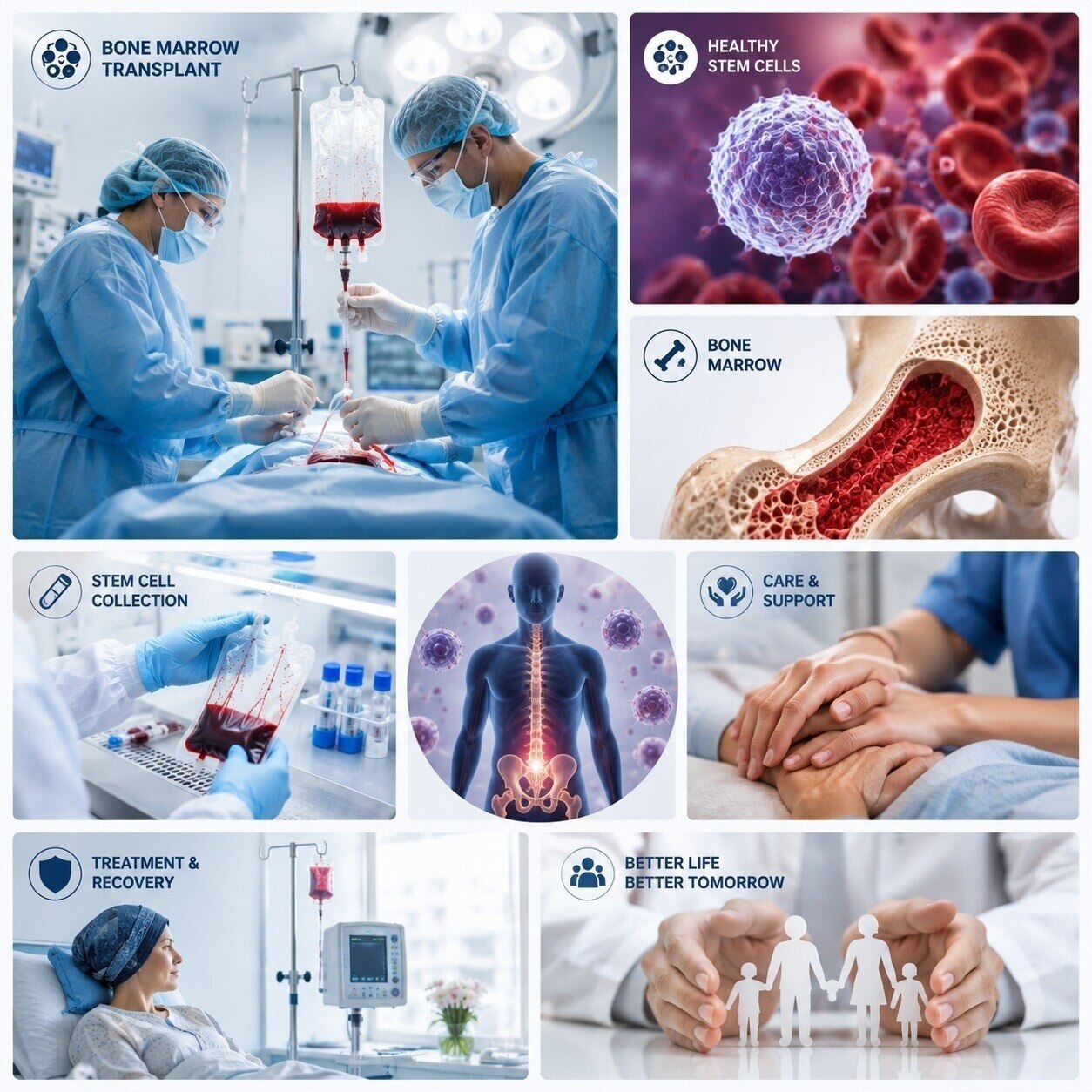
Peripheral blood stem cells are used for many bone marrow transplant care options. Granulocyte-colony stimulating factor moves blood-forming stem cells from marrow into the bloodstream; an apheresis machine then collects them, and the cells can be cryopreserved. Plerixafor may be added when mobilisation is poor.
The cells travel into your bloodstream through a vein, often a central line. They are not surgically implanted into bone. Asking about these decisions is part of bone marrow transplant specialist services, including the donor search, collection plan and catheter risks such as infection or thrombosis.
What conditioning and infusion include during admission
Admission usually begins with central venous access, such as a tunneled catheter or peripherally inserted central catheter, so chemotherapy, medicines, transfusions and stem cells can be given safely. Conditioning chemotherapy, immunotherapy or total-body irradiation follows when indicated. It reduces malignant cells, suppresses immunity and creates marrow conditions for engraftment.
| Approach | Intensity and toxicity | Main treatment principle |
|---|---|---|
| Myeloablative | Highest intensity; greater organ, infection and mucosal toxicity | Strong disease control and marrow ablation |
| Reduced-intensity | Lower intensity, but still carries serious toxicity | Combines disease control with donor immune effects |
| Nonmyeloablative | Lowest conditioning intensity | Relies most heavily on the donor graft-versus-tumour effect |
The infusion is intravenous, usually through the central line, and you remain awake; sedation is unnecessary unless another clinical reason exists. Nurses monitor temperature, pulse, blood pressure, oxygen level and symptoms during and after infusion because fever, chills, nausea, breathing difficulty or blood-pressure changes can occur.
Transplant treatment inclusions commonly cover antiemetics, analgesia, nutrition support, mouth care for mucositis, red-cell and platelet transfusions, and antibacterial, antiviral and antifungal prophylaxis. Daily reviews include blood counts, electrolytes, kidney and liver function, weight, fluid balance and medication toxicity.
Allogeneic transplantation requires a graft-versus-host disease prevention plan, such as tacrolimus or cyclosporine with additional immunosuppression, or post-transplant cyclophosphamide. These drugs require level, kidney and blood-pressure monitoring and do not remove graft-versus-host disease risk. For bone marrow transplant specialist treatment, ask for details of the exact conditioning, monitoring and support plan.
What recovery involves after the stem-cell infusion
Neutrophil recovery often takes about two to four weeks after infusion. Engraftment means donor or autologous stem cells have resumed blood production; clinicians track it with serial complete blood counts and, when needed, chimerism testing or a marrow examination.
| Recovery stage | What is monitored | What can prolong it |
|---|---|---|
| Early admission | Blood counts, kidney and liver function, electrolytes, weight, fluid balance, symptoms and drug toxicity | Fever, infection, mucositis, poor nutrition, fluid problems, organ toxicity, delayed engraftment or graft-versus-host disease |
| After discharge | Medication adherence, immunosuppressant levels, graft function and CMV or other viral tests when indicated | Recurrent infection, graft-versus-host disease or unstable blood counts |
| Long-term follow-up | Relapse or residual disease, chronic graft-versus-host disease, endocrine and organ effects, bone health, cataracts, secondary cancers, psychosocial health and cognition | Complications requiring treatment for months or years |
Discharge does not end protection. Follow infection precautions for food, water and exposure; take prescribed antibacterial, antiviral or antifungal medicines; and seek urgent assessment for a fever or new symptoms. Live vaccines are avoided while you remain significantly immunocompromised, and revaccination begins after immune recovery according to the transplant team’s schedule.
Bone marrow transplant care options include scheduled blood tests, transfusion support and specialist review rather than one final check. Bone marrow transplant specialist services should also coordinate relapse surveillance, chronic graft-versus-host disease treatment, medication monitoring and late-effect screening. Immune recovery and graft function can require follow-up for months or years.
What to ask during a transplant consultation in Pune
Before consenting, ask for a written pathway showing who handles each stage of your bone marrow transplant consultation in Pune. A transplant service may coordinate care without providing every test, donor source, intensive-care facility or fertility-preservation option at the same site.
Ask whether the team will provide:
- Diagnosis and eligibility review, including pathology, flow cytometry, cytogenetics and molecular results.
- HLA typing, donor search and comparison of matched sibling, matched unrelated, haploidentical and cord-blood options.
- Fertility counselling, sperm, egg, embryo or ovarian-tissue referral, vaccination review and dental assessment before conditioning.
- Kidney, liver, heart and lung testing, plus infection screening.
- Stem-cell collection coordination, including the collection centre and transport plan.
- Conditioning selection, central-line insertion and care, inpatient monitoring, transfusions, antibacterial, antiviral and antifungal prophylaxis.
- Graft-versus-host disease prevention for an allogeneic transplant.
- Discharge medicines, emergency access, infection instructions and long-term surveillance for relapse, graft function, chronic graft-versus-host disease and late effects.
Compare the practical arrangement, not the clinic label:
| Service | Ask | Why it matters |
|---|---|---|
| On-site | Is it performed at this centre? | Fewer transfers and hand-offs |
| Referred | Which named centre manages it? | Clarifies coordination and travel |
| Outside plan | What costs or delays are excluded? | Prevents unexpected decisions |
Ask who manages fever or intensive-care emergencies, how often follow-up occurs and which doctor remains responsible. Dr Chandrakant Lahane can help map these questions during consultation in Yerawada, Pune, but verify the actual team, facilities and follow-up before treatment.
Related service
Bone Marrow Transplant Dr. Chandrakant Lahane provides specialized consultation and comprehensive care for patients who may require a bone marrow or stem cell transplant... View service → |
Frequently asked questions
How does a bone marrow transplant specialist confirm eligibility?
The specialist confirms the diagnosis, reviews pathology and previous treatment, measures disease status and risk, examines you, records performance status and compares non-transplant options.
How do donor type and stem-cell source change the transplant plan?
The plan depends on donor compatibility and whether stem cells come from bone marrow, peripheral blood or umbilical cord blood. These choices affect collection, conditioning, complications and monitoring.
What happens during conditioning and stem-cell infusion?
During admission, conditioning treatment prepares the body for the transplant. The collected stem cells are then infused through a central venous line, followed by close monitoring for early complications.
What does recovery involve after stem-cell infusion?
Recovery includes monitoring blood counts, infection prevention, medicines, transfusions when needed, management of graft-versus-host disease risk and scheduled follow-up after discharge.
What should you ask during a transplant consultation in Pune?
Ask why transplant is recommended, which alternatives exist, how donor matching will work, what admission includes, which complications to expect and how follow-up care will be arranged.